"Beyond the Danda" doesn't mean abandoning structure, accountability, or performance. It doesn't mean removing pressure.
It means redefining Which Danda you use and where you use it.
Here's how to shift from the first to the second by practicing Four D’s.
"Management by Danda"
(Fear, Control, Compliance)
To
"Management by the Five D's"
(Productive Pressure)
The First Four D's: What Organizations Must Provide
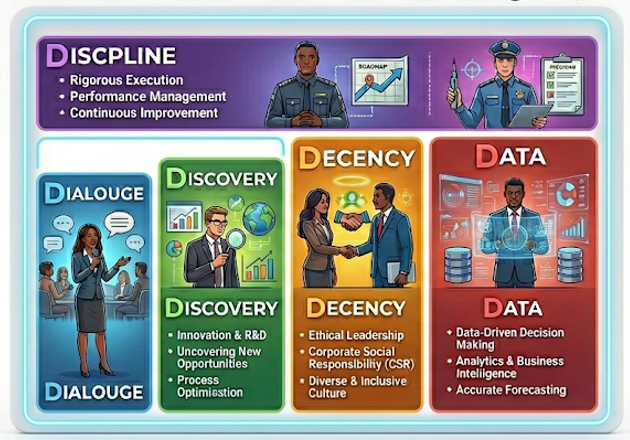
First D: Management by Dialogue
Replace one-way commands with two-way conversations.
Instead of: "Here's what you need to do."
Try: "Here's what we need to achieve. How would you approach it?"
Instead of: "Why didn't this work?"
Try: "Walk me through your thinking. What did you learn?"
Dialogue doesn't mean endless discussion. It means shared understanding before individual execution.
What it looks like: Manager frames outcome and context. Employee proposes approach. Manager provides input. They co-create solution. Employee sees their input matters.
Second D: Management by Discovery
Replace fear of failure with structured experimentation.
Instead of: "Don't make mistakes."
Try: "Try this approach. If it doesn't work in 2 weeks, we'll adjust."
Instead of: "Why did you fail?"
Try: "What did we discover? How does it inform our next move?"
Discovery means treating business as ongoing learning, not perfect execution.
What it looks like: Manager sets budget and timeline for experiments. Employee runs tests, documents hypotheses. Failures become data, not judgment. Learning compounds.
Third D: Management by Decency
Replace fear and humiliation with respect and dignity.
Instead of: "Your work is shit. Fix it."
Try: "This doesn't meet the standard. Here's what needs to change and why."
Instead of: Public callouts in meetings.
Try: Private feedback with clear expectations.
Decency doesn't mean lowering standards. It means maintaining them without destroying people. High standards AND dignity are both possible.
Fourth D: Management by Data
Replace gut-feel hierarchy with evidence-based decisions.
Instead of: "I've been here 20 years, I know what works."
Try: "Here's what the data shows. Here's what we should test."
Instead of: Decisions based on who's senior.
Try: Decisions based on what's true.
Data means replacing power dynamics with factual dynamics.
Fifth D: Discipline (Employees Must Bring)
The first four D's eliminate wasteful Danda. But they don't answer the question everyone's thinking: Once you remove fear, what makes people work?
This is where most transformation dies. Organizations remove the stick. Expect performance to continue. Then get shocked when productivity drops.
The answer isn't softer Danda or better Danda.
The answer is Discipline.
Not the discipline you impose. The discipline people bring. Self-discipline. Ownership.
The Geeta Paradox
The Bhagavad Geeta says:
कर्मण्येवाधिकारस्ते मा फलेषु कदाचन।
(Karmanye Vadhikaraste, Ma Phaleshu Kadachana.)
Meaning: You have the right to do your duty, but not to the fruits of your actions.
Beautiful philosophy. Impossible in corporate reality. We work for promotions. Salary hikes. Career growth. Recognition. We can't pretend outcomes don't matter.
But here's what we can do: Work with dedication, not just for rewards.
Big difference.
Working for rewards means: Do minimum to get promoted. Game the system. Look busy. Stop caring once the raise hits your account.
Working with dedication means: Give your best regardless of recognition. Take ownership because the work matters. Deliver quality because that's your standard. Care about outcomes even when nobody's watching.
One is transactional. One is professional.
One needs constant Danda. One is self-sustaining.
What Discipline Actually Means? Discipline isn't 14-hour days. That's often just Bhasad, appearing busy to avoid the Danda.
Real discipline looks like:
Finish work on time, not at last minute. Not because boss is chasing. Because that's how professionals work.
Surface problems early, not hide them till they explode. Not because you'll get punished for hiding. Because solving problems early is smarter.
Own outcomes, not just tasks. Not because your KPIs demand it. Because outcomes matter.
Say no to bad ideas, even from senior people. Not because you're protected by "psychological safety." Because protecting the company from bad decisions is literally your job.
Experiment and learn, not just execute. Not because innovation budget exists. Because staying relevant requires learning.
This doesn't come from Danda. It comes from self-respect.
The Complete Framework
Dialogue creates space for honesty.
Discovery creates room for experiments.
Decency removes daily humiliation.
Data enables merit-based decisions.
Discipline creates path for consistency.
Together, they replace Management Danda with something that lasts long.