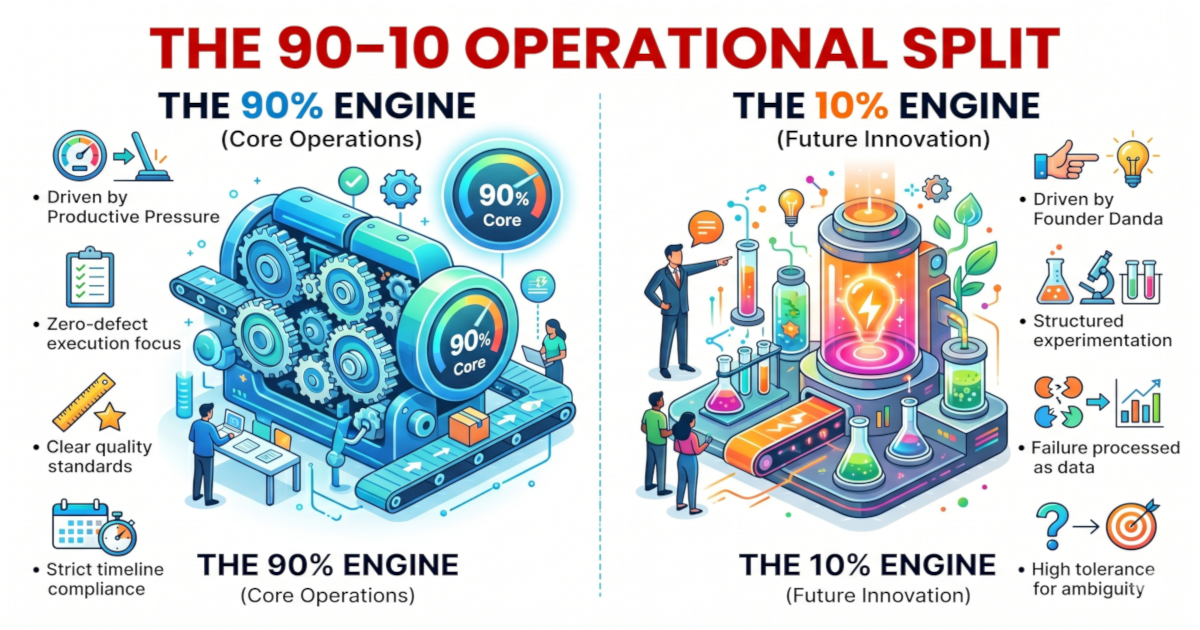
Most business books criticize managers. Most employees complain about the Danda (the stick). But very few people pause to ask a much deeper question: What if employees are willing participants in the Danda system?
What if this fear-based management style survives not just because managers need it, but because employees depend on it?
The Freedom Experiment
For decades, corporate culture has been heavily criticized for its obsession with pressure, aggressive deadlines, constant escalation, and tight control. Employees complain about micromanagement. HR teams organize offsites about "empowerment" and "trust."
Yet, an interesting pattern emerges whenever organizations genuinely try to reduce control. People become deeply uncomfortable.
To understand why, imagine two managers:
- The Directive Manager: He assigns specific tasks, sets rigid deadlines, reviews progress daily, and constantly reminds the team what needs to be done. His employees constantly complain that he micromanages everything.
- The Empowering Manager: She takes the exact opposite approach. She hands over a project and tells her team:
"You own this area. You have the expertise. Make the decisions and just keep me informed."
On paper, every employee claims they prefer the second manager. That is, until they have to actually work for her. The moment true freedom is granted; the anxiety sets in:
- What if I make the wrong decision?
- What if leadership disagrees with my approach?
- What if something goes wrong later and I get blamed?
Without realizing it, many employees begin actively seeking the very thing they once criticized: Strict Direction.
The Psychology of Danda: Clarity Over Accountability
The secret appeal of the Danda is not fear. It is clarity.
A manager who tells you exactly what to do removes all ambiguity. The decision has already been made for you. The risk has been successfully transferred upward. Your responsibility feels significantly lighter because you are merely an executor, not an owner.
Freedom sounds incredibly attractive until it arrives carrying its heavy companion: accountability.
This is exactly why organizations experience massive resistance when they attempt to create empowered cultures. Empowerment is almost always sold as a benefit. In reality, it is a burden. It requires judgment, professional courage, and the willingness to accept the consequences of a bad call. Not everyone is prepared for that transition.
The School We Never Leave
We cannot entirely blame employees for this hesitation. This behaviour is conditioned into us long before we enter corporate life.
Most of us spend nearly two decades in an education system built entirely around instruction and compliance:
- Teachers define what success looks like.
- Examinations define our priorities.
- The "correct" answer already exists; our only job is to memorize and find it.
Very few students are ever rewarded for questioning the question itself. Then, one day, organizations suddenly expect these same individuals to transform into independent thinkers and risk-takers.
Many professionals have spent their entire lives optimizing for compliance rather than ownership. When freedom finally arrives, it feels less like liberation and more like free-fall.
The Unwritten "Danda Contract"
Over time, an unwritten contract develops within the workplace:
- Managers provide direction and carry the decision risk.
- Employees provide compliance and carry the execution responsibility.
Both sides fully understand the arrangement. Neither side is entirely satisfied with it. Yet, both become mutually dependent on it.
This is why the danda survives even in organizations that publicly claim to despise it. The system provides predictability, and human beings find immense comfort in predictability.
The Real Challenge
The challenge for organizations is not removing the Danda overnight. If you remove the stick without preparation, you don't get innovation, you get chaos.
The real challenge is helping people develop the capability to operate without it. True ownership cannot be magically activated via an HR town hall announcement. It must be built gradually through deliberate cultural shifts:
- Decision-making must be practiced.
- Failure must be tolerated without immediate punishment.
- Trust must be actively earned on both sides.
Employees need to learn how to function with freedom, just as desperately as managers need to learn how to lead without absolute control.
The Takeaway
The biggest success of the Danda is not that it controls people. The biggest success of the Danda is that, over time, people begin to believe they need it.
The exact moment an employee stops waiting for instructions and starts taking ownership, the power of the stick begins to break. And perhaps that is the real transformation organizations need, not just the removal of pressure, but the development of professionals who are so capable and accountable that they simply no longer require it.