Why Organizations Need Two Different Management Systems
One of the biggest management mistakes of the modern corporation is the belief that a single management style can be applied uniformly across an entire organization. Most companies attempt to run everything from operations, sales, customer service, product development, to strategy, innovation and experimentation, using the same rules, the same metrics, and often the same pressure mechanisms.
The result is predictable. Organizations become highly efficient at executing today's business while gradually losing the ability to build tomorrow's business.
When leaders realize their corporate culture has turned into bureaucratic, pressure-driven, they usually default to an aggressive overcorrection. The instinctive response is often to swing to the opposite extreme. Announce a new era of unbridled flexibility and proclaim that the old command-and-control loops are dead. New cultural values are announced. Employees are encouraged to take ownership. Layers of control are removed. Teams are told to experiment, challenge assumptions, and work with greater autonomy.
For a brief period, optimism spreads through the organization. Employees welcome the change. Managers embrace the language of empowerment. Leadership celebrates the arrival of a new culture.
Then reality intervenes
A critical deadline is missed. A customer escalation emerges. A project overruns its budget. A team misuses the newly granted flexibility. Suddenly, the confidence in empowerment begins to weaken. Additional reviews are introduced. Reporting requirements increase. Approvals return. Within months, the organization finds itself operating exactly as it did before, except employees are now even more cynical because they have experienced both freedom and its withdrawal.
The problem is not that empowerment failed. The problem is that organizations frequently misunderstand the role of pressure in business. Every business operates within constraints. Customers expect delivery. Investors expect returns. Markets reward speed and reliability. Accountability is not optional. Without discipline, organizations drift. Without deadlines, priorities blur. Without ownership, execution suffers.
The opposite of pressure is not the absence of pressure. Pressure is a fundamental business reality; without it, projects stall and execution slips.
The real challenge is understanding that not every part of the organization should be managed in the same way. The secret to scaling a world-class organization lies in implementing a 90–10 Operational Split.
The 90-10 Operational Framework
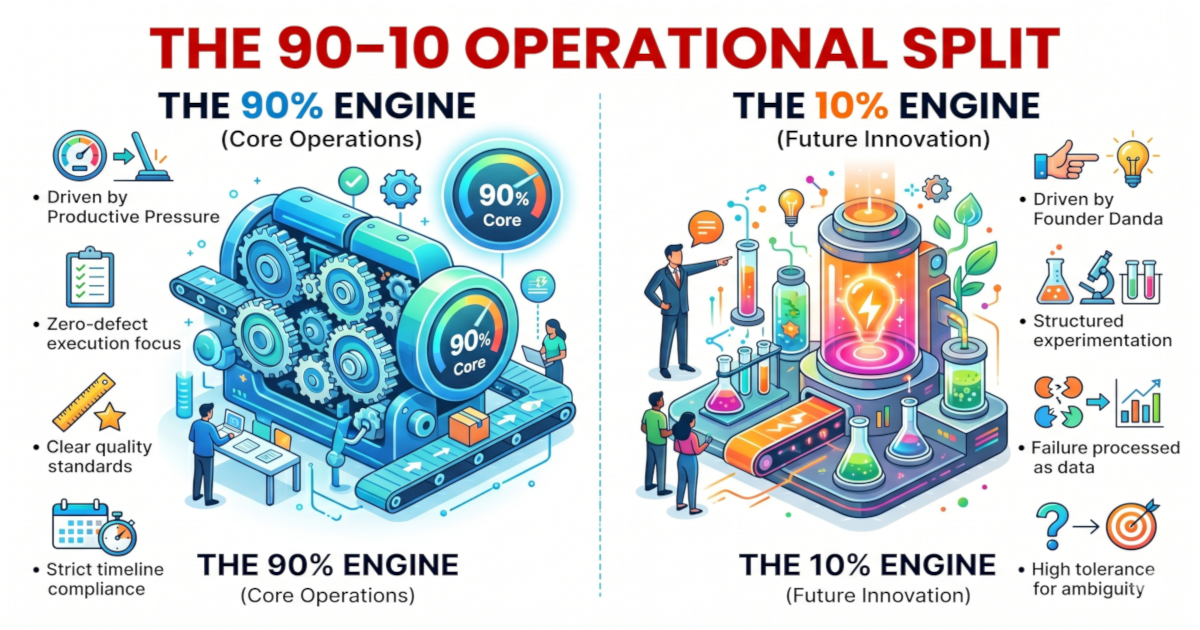
An enterprise must run using two distinctly calibrated operational engines:
Ø The 90% Engine: Core Operations
The ninety percent engine requires discipline. It requires predictability, consistency, accountability, and performance management. Customers expect reliability, not experimentation. A bank cannot experiment with transaction accuracy. An airline cannot experiment with safety procedures. A manufacturing plant cannot experiment with quality controls on every production run. The core business depends upon operational excellence, and operational excellence requires structure. If deadlines are missed here, customer satisfaction collapses and revenue drops.
However, you must swap out toxic, personalized fear for Productive Discipline. This means establishing clear, transparent metrics and objective data paths rather than relying on a manager's mood swings or public callouts.
Ø The 10% Engine: Future Innovation
The remaining ten percent of organizational capacity must be aggressively directed toward building the company's future. This is dedicated to new product development, exploring experimental business lines, and deep R&D.
This 10% engine must be completely isolated from the zero-defect rules of the 90% engine. Here, the leadership style must mirror Founder Danda. Teams must have the psychological safety to run rapid, unconventional tests. If an experiment fails within a designated two-week window, the team isn't penalized; the failure is documented as critical research data that refines the company's next strategic move.
Innovation is about exploring uncertainty. Innovation begins with unpredictable outcomes. Innovation rewards learning. This is why the ten percent engine must be treated differently.
Organizations need a protected innovation zone where teams can test ideas, challenge assumptions, and explore opportunities without being subjected to the same rules that govern day-to-day operations. This does not mean eliminating accountability. Innovation without accountability quickly becomes chaos. However, the accountability mechanism must change. In operations, teams are accountable for results. In innovation, teams are accountable for learning.
Implementing the Split
To make the 90–10 framework stick, the organization must take definitive structural actions:
- Reduce Corporate Bloat: Audit the headquarters' headcount. When you employ more administrative layers than there is real work, executives instinctively invent bureaucratic tasks like demanding extra reports or scheduling alignment meetings, just to look occupied and secure their visibility. Strip away the bloat to focus resources on value creation over perception management.
- Establish Clear Operational Boundaries: Ensure that the leaders running your 90% core engine do not have the authority to veto or choke the resources of the 10% innovation sandbox. Innovation will always lose if it has to constantly beg the core business for permission to exist.
- Enforce Zero Tolerance for Decency Violations: Elite performance and human dignity can coexist. Public insults or toxic behavior must be treated as a systemic failure, regardless of how high the manager's sales numbers are.
The Way Forward
The 90–10 Operational Split offers a practical way forward. It acknowledges that discipline and innovation are both essential. It recognizes that pressure has a role in execution but becomes destructive when applied indiscriminately. Most importantly, it accepts a fundamental reality that many organizations resist: the management system required to run today's business is not necessarily the management system required to create tomorrow's business.
The organizations that will thrive in the coming decade will not be those that eliminate pressure entirely, nor those that continue to rely exclusively upon it. They will be those that learn how to separate execution from exploration, discipline from experimentation, and control from creativity.
The future belongs to organizations that can operate with the precision of a machine in their core business while thinking with the curiosity of a startup at their edges.
That balance may well become the defining leadership challenge of the next decade.