Why the Market Values Tech Sovereignty Over Sales Volume
For nearly three decades, Hero MotoCorp and Bajaj Auto have been two of the most influential companies in India's two-wheeler industry. Both are iconic brands. Both have built deep distribution networks. Both have shaped the mobility aspirations of crores of Indians.
Yet an interesting question continues to puzzle investors and management thinkers alike.
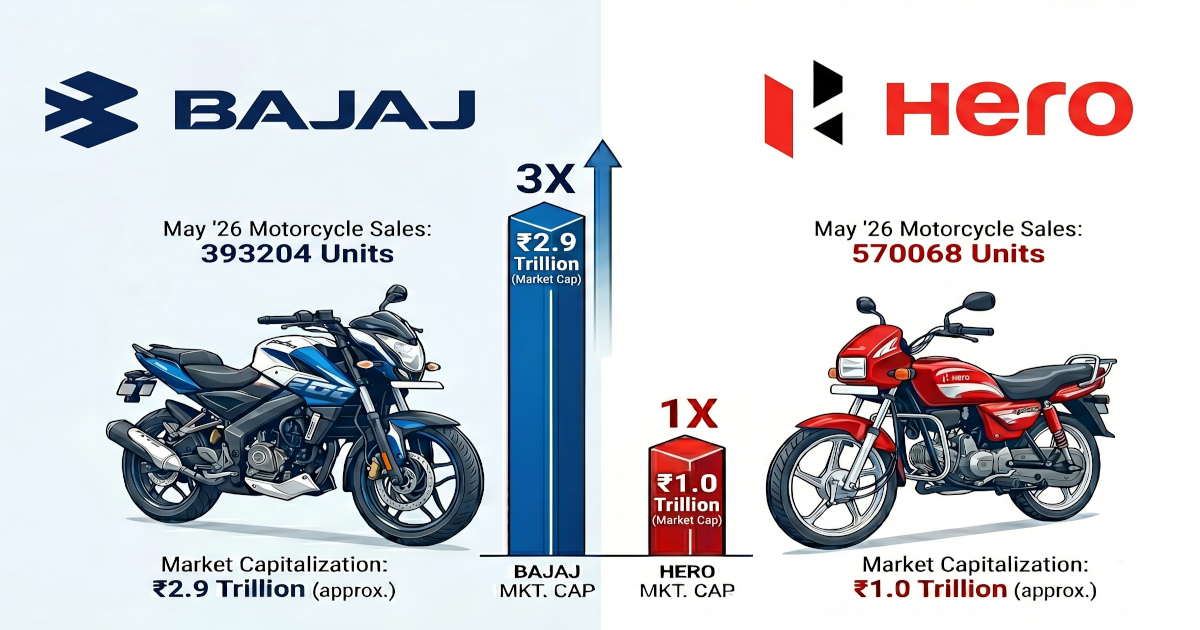
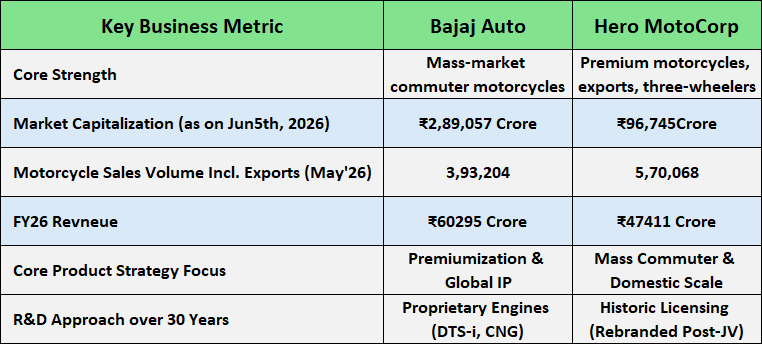
Bajaj Auto commands a market capitalization that is roughly 2.4 times larger than Hero's, despite selling almost half number of units.
This valuation gap is not a speculative anomaly. It is a calculated "sovereignty premium.” The compounding reward that the stock market pays to an organization that owns its intellectual property (IP), builds domestic R&D capability, and expands globally, rather than renting foreign tech to optimize local commuter volumes.
The curious case of Bajaj Auto provides a rigorous 30-year operational blueprint of why long-term capability-building will always outperform short-term execution scale.
The Empirical Divide: Financial & Operational Comparison
To understand why the public market prices a Bajaj vehicle with a massive valuation premium compared to a Hero vehicle, one must look closely at the underlying financial reality:
The Legacy of Two Different Strategies
The root of this curious case began three decades ago. In the mid-1990s, both manufacturers relied heavily on international technology partners to build their portfolios. Bajaj Auto held a licensing partnership with Kawasaki, while Hero operated under the highly successful Hero Honda joint venture.
The critical turning point came down to a fundamental choice: Solve daily operational deadlines or intentionally build the future. Under Rajiv Bajaj’s leadership, Bajaj Auto realized that relying forever on foreign technology hand-outs would relegate the firm to a low-margin assembler. In 1995, the company began investing heavily in its in-house R&D capabilities.
This multi-year bet culminated in the 2003 rollout of the DTS-i (Digital Twin Spark Ignition) engine technology. Designed entirely in Pune, this proprietary engine configuration squeezed 18% better fuel economy and 12% more power out of a standard cylinder. By owning the underlying patent, Bajaj could rapidly iterate product design, lower costs, and scale the iconic Pulsar brand without sending millions of dollars abroad in technological licensing fees.
In contrast, Hero built its success by mastering the commuter motorcycle segment. Products such as Splendor became synonymous with reliability, affordability, and fuel efficiency. The strategy was simple and extraordinarily successful: reach every town, every village, and every first-time buyer. Hero did not build foundational engine engineering muscles. When the joint venture finally fractured in 2010, Hero had to buy out Honda's stake and start racing to construct an internal R&D ecosystem from scratch, while continuing to pay massive technical royalties during the transition phase.
The R&D Advantage
One of the factors behind Bajaj's valuation is its long-term commitment to product development.
For many years, Indian two-wheeler manufacturers operated in a market where execution mattered more than innovation. Distribution, dealer reach, supply chains, and manufacturing efficiency determined success.
However, as consumer preferences evolved, differentiation became increasingly important.
Bajaj invested heavily in creating platforms that could serve multiple brands, geographies, and customer segments. The company's engineering partnerships with KTM and Triumph helped it develop capabilities that extended far beyond the Indian commuter market. These investments created intellectual property, engineering expertise, and global credibility that investors increasingly value.
Hero, by contrast, remained heavily dependent on the commuter segment for a longer period. While this generated impressive volumes, it limited pricing power and profitability relative to premium categories.
Global Hedging
Another important difference is international diversification. Because Bajaj owned its underlying intellectual property, the company possessed the absolute sovereignty to export its vehicles anywhere in the world without seeking permissions from a foreign parent partner.
Over the last 15 years, Bajaj systematically built an international fortress, spreading into Latin America, Africa, and ASEAN markets. Today, nearly 46% of all two-wheelers Bajaj manufactures leave Indian shores. This global footprint functions as an excellent macroeconomic hedge. When rural domestic demand softens in India due to weak monsoons or inflationary pressures, Bajaj's foreign exchange earnings buffer its margins.
Furthermore, because Bajaj’s cash flows were structurally protected by proprietary products and global revenue lines, they had the leverage to acquire strategic stakes in international performance brands—such as their alliance with KTM and co-development ventures with Triumph. These partnerships allowed them to move aggressively into highly lucrative, premium global segments, leaving the entry-level commuter wars behind.
Investors generally reward companies that have multiple growth engines rather than dependence on a single market.
A Lesson from Management by Danda
The comparison between Hero and Bajaj offers an important management lesson. Organizations often become trapped in what Management by Danda describes as the execution loop. They become exceptionally good at running the current business. Processes improve. Efficiency improves. Volumes increase.
But future value is rarely created by execution alone. Future value is created when organizations deliberately allocate resources to innovation, capability building, experimentation, and long-term strategic bets.
Neither approach is inherently right or wrong. In fact, Hero remains one of India's most successful manufacturing stories. But the market often places a premium on companies that demonstrate an ability to create future growth engines rather than simply expand existing ones.
The curious case of Bajaj Auto proves that owning intellectual property transforms an enterprise from an assembly plant into a creator of global value.
The resulting 3x valuation premium is simply the public market validating an uncomfortable corporate truth: In the modern global arena, execution excellence can always be copied, but true technological sovereignty is irreplaceable.